
Why Your ADHD Teen Lies About Homework (And How to Stop the Cycle)
Parents of ADHD teens in grades 6 through 12: Your teen just told you homework is done. You want to believe them. You check the portal anyway.
Three missing assignments. A zero on last week's project. An email from the teacher asking about late work.
They lied. Again.
The anger hits first. Then the confusion. Why would they lie when getting caught is guaranteed? Don't they know you have portal access?
You've had the talk about honesty. You've taken away the phone. You've grounded them. You've tried rewards for telling the truth.
Nothing works.
Here is what nobody tells you:
Your teen is not lying to deceive you. They are lying to escape shame.
And until you understand the difference, the lying will not stop.
Picture this instead:
You check your phone over lunch. A dashboard shows three assignments due this week. Two complete. One needs attention. You know this without asking.
Dinner happens. No interrogation. No "did you do your homework?" Your teen notices you stopped nagging.
That is what happens when you stop trying to catch lies. And start building systems that make lying pointless.
I know this works because I was that teen. I lied about homework every night. I'm 23 now. I build systems that replace interrogation with visibility for families with ADHD teens.
Why Your ADHD Teen Lies About Homework
I was the ADHD kid who lied about homework every night.
I told my parents the project was turned in when it was not. I said I did not have homework when I had three assignments due. I claimed the teacher never posted the grades when I just did not want to show them.
I was not trying to manipulate anyone. I was drowning in shame. The lie was a life raft.
Every time I could not start an assignment, I felt broken. Every missing grade confirmed what I already believed: I was stupid, lazy, and disappointing everyone.
The lie was never about the homework. The lie was about escaping the conversation where I had to admit I failed. Again.
The 5 Reasons ADHD Teens Lie
Reason 1: Shame Avoidance
Your teen knows the homework is not done. They also know they should have done it. The gap between "should" and "did" creates shame.
The lie is an escape hatch. It delays the shame. Even if the delay only lasts until you check the portal, those few hours of relief feel worth it.
Reason 2: Impulsivity Fires Before Thought
You ask: "Did you finish your homework?"
Their mouth says: "Yes."
Their brain catches up three seconds later: "Wait, that was not true."
But now they are committed. Backing out feels more shameful than doubling down.
Reason 3: The Task Feels Impossible
Task initiation is the executive function that lets you start something. ADHD impairs this function.
Your teen might stare at the assignment for an hour. Wanting to do it. Unable to begin.
When you ask about homework, they have two options: Admit they sat there for an hour and could not start. Or say it is done.
They pick easier every time.
Reason 4: Previous Honesty Was Punished
Think back. What happened the last time your teen said "I could not do my homework"?
Did you lecture them? Take away the phone? Express disappointment?
Your teen learned that honesty leads to bad outcomes. Lying delays bad outcomes. So they lie.
Reason 5: Consequence Prediction Fails
ADHD brains struggle to connect present actions to future consequences. The lie feels like relief right now. Getting caught feels far away and abstract.
The ADHD Shame Cycle
Here is how the cycle works:
- Task appears: Homework is assigned
- Task feels impossible: Executive function makes starting hard
- Avoidance happens: Teen does not start
- Deadline passes: Assignment becomes "missing"
- Shame builds: Teen feels broken for failing again
- Parent asks: "Did you do your homework?"
- Lie happens: "Yes" (to escape shame)
- Lie discovered: Parent checks portal
- More shame: Now they are a liar AND a failure
- Next task harder: Shame compounds
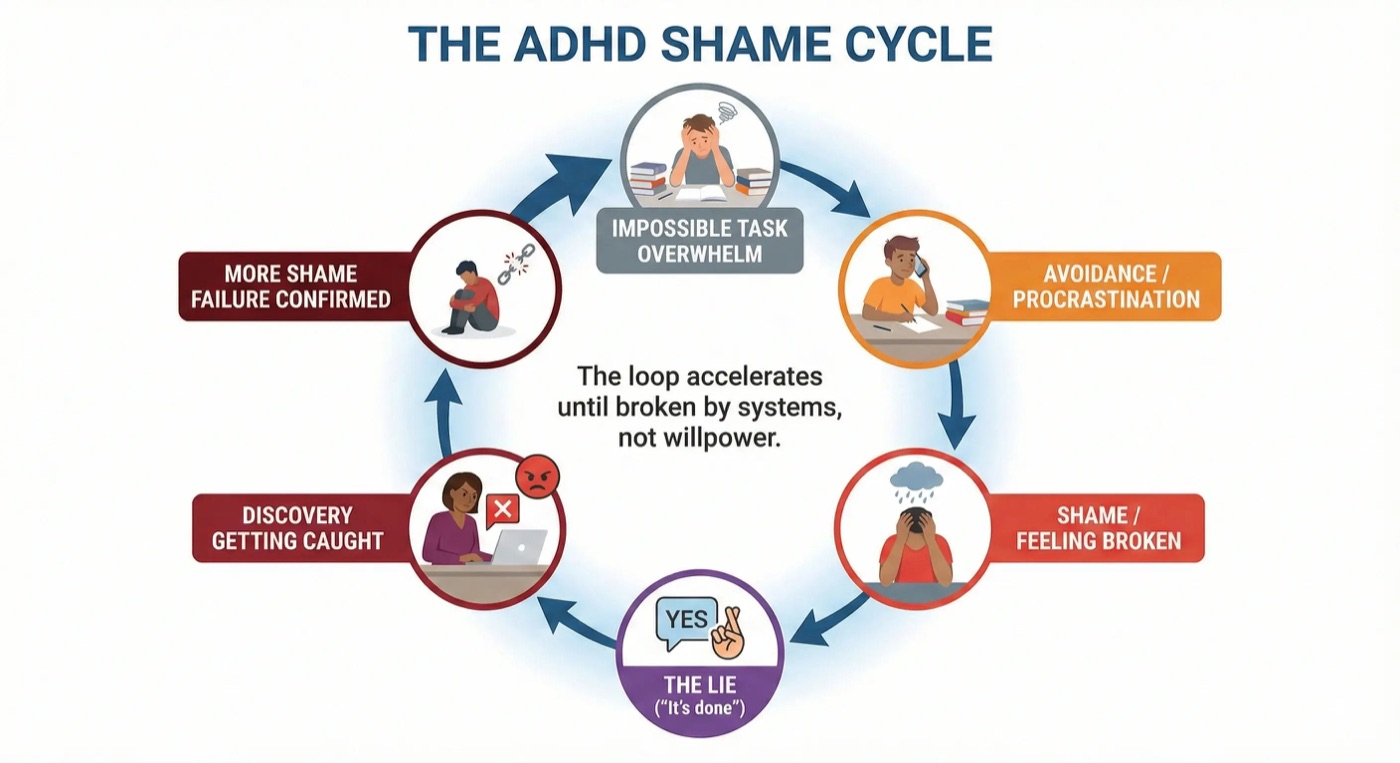
Notice what is missing: The teen never gets better at homework. The cycle does not improve. It only accelerates.
Punishment does not break this cycle. It adds fuel. More shame equals more lying equals more shame.
What breaks the cycle is removing the need for the lie in the first place.
What Doesn't Work
Before we build what works, let's name what doesn't.
| Approach | What It Does | Why It Fails |
|---|---|---|
| Punishment | Creates consequences | Adds shame, increases lying |
| Monitoring | Creates oversight | Unsustainable, breeds resentment |
| Rewards | Creates incentives | Shame overwhelms rewards |
| Talks | Appeals to values | Knowledge does not override shame |
| Trust resets | Offers fresh starts | Nothing structural changes |
| The Verifier | Makes truth visible | Runs without teen remembering |
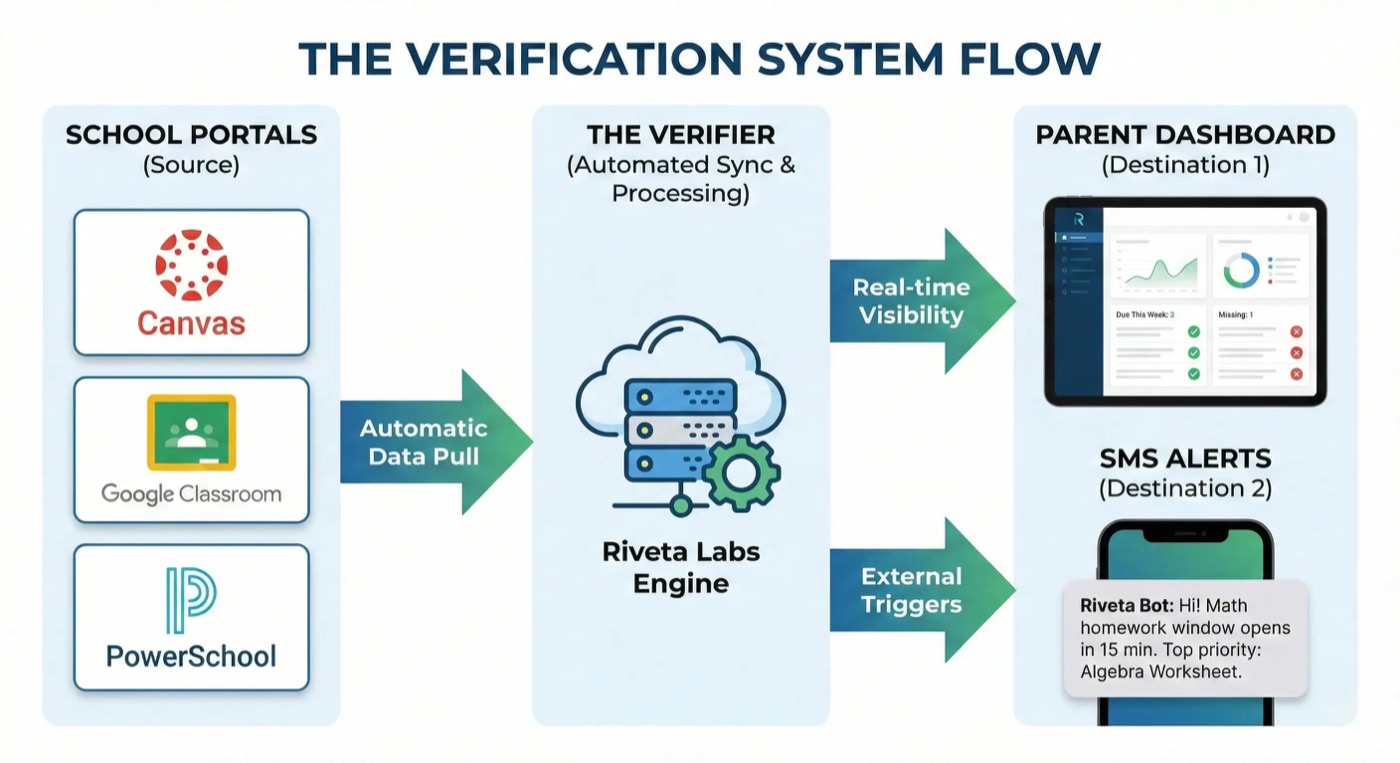
Everything on this list tries to change your teen. The Verifier changes the environment instead.
Done reading? Here's the shortcut.
You can build verification systems yourself. It takes time and technical comfort.
Or use OneTracker. It syncs with Canvas automatically and shows you what is due without asking your teen anything. $149/mo. Homework-Running-or-Free guarantee.
Start with OneTracker to keep track of Canvas assignments. Want help with setup? Explore the 10-Day Homework Sprint.
The Shift: Visibility Over Interrogation
Here is the core insight:
You can not punish away shame-based lying. But you can make lying unnecessary.
The question "Did you do your homework?" is the trigger. It creates a situation where your teen must choose between admitting failure (shame) or lying (relief).
Remove the question and you remove the trigger.
When the truth is visible by default, there is nothing to ask. When there is nothing to ask, there is nothing to lie about. When lying becomes pointless, lying stops.
This is infrastructure thinking. No CEO relies on employees to self-report mistakes. They build dashboards that show reality. Your teen deserves the same approach.
Free Resource: The 3-2-1 Launch System
A task initiation protocol for ADHD brains. It removes the "just start" barrier. When homework starts, there is less to lie about.
The 5-Step System That Stops Lying
Step 1: Remove the Question
Stop asking "Did you do your homework?"
This question invites a lie. It puts your teen on the spot. It triggers shame. And you already know you can not trust the answer.
Replace the question with visibility.
Step 2: Build Automatic Visibility
Set up systems that show you the truth without your teen having to admit it:
- Parent portal access: Most schools offer parent accounts. Check assignments directly instead of asking.
- Shared tracker: A simple shared document where assignments are visible to both of you.
- Automated sync: Tools that pull assignments from the school portal into a single dashboard.
The key: Your teen knows you can see everything. Lying becomes pointless because the truth is already visible.
Step 3: Address the Shame Source
Find out why the homework is not getting done:
- Is it too long? Request accommodations for reduced assignments.
- Is it too hard? Get tutoring support or 504/IEP adjustments.
- Can they not start? Implement a task initiation protocol.
- Do they forget it exists? Use SMS reminders.
When the task becomes possible, the avoidance decreases. When avoidance decreases, the shame decreases. When shame decreases, lying becomes unnecessary.
Step 4: Make Honesty Safer Than Lying
Create conditions where telling the truth is the path of least resistance:
- When they admit struggle, respond with help instead of disappointment
- Praise honesty about incomplete work more than you praise completed work
- Make "I could not do it" the start of problem-solving, not punishment
Step 5: Install External Accountability
Your teen's brain will not remember to do homework. Stop expecting it to.
Build external systems that hold the process accountable:
- SMS reminders at specific times
- Visual trackers in common spaces
- Automated daily check-ins that do not require your nagging
The system does the remembering. The teen does the work. Nobody has to lie about what was forgotten.
What to Say When You Catch a Lie
The lie already happened. Now what?
Don't Say:
- "I can not believe you lied to me"
- "How can I ever trust you?"
- "You're a liar"
- "After everything I've done for you"
These add shame. Shame caused the lying. More shame causes more lying.
Say Instead:
"I can see from the portal that the assignment is not done. What got in the way?"
This statement:
- Shows you already know the truth
- Focuses on the obstacle, not the character
- Opens problem-solving instead of punishment
- Keeps the relationship intact
If They Admit Struggle:
"Thank you for telling me what's hard. Let's figure out how to make this easier."
If They Shut Down:
"I'm not here to punish you. I want to fix the system so you don't have to lie. We'll talk when you're ready."
Three Paths Forward
Path 1: Start with OneTracker
OneTracker syncs with Canvas and shows you every assignment on your phone. Alerts fire before deadlines. Your teen gets an SMS at homework time. You see the truth without asking.
What it costs: $149/mo. Homework-Running-or-Free guarantee. No sprint required.
Best for: Parents who want the visibility system running now without a big time investment.
Path 2: Build It Yourself
Everything in this guide can be built with free tools and your time.
What it costs: Your time. Expect 3-5 hours to set up. 1-2 hours weekly to maintain.
Best for: Parents with technical comfort and available time.
Get the Semester Rollover Playbook
Get the 3-2-1 Launch System
Get the 504/IEP Activation Guide
Path 3: Done For You
The 10-Day Homework Sprint offers hands-on help with OneTracker setup. We tune the homework launch routine with your teen.
Best for: Parents who want custom systems built for their family.
Want more hands-on help? The 10-Day Homework Sprint offers help setting up OneTracker and your teen’s homework launch routine.
FAQ
Why do ADHD kids lie about homework?
ADHD kids lie about homework to avoid shame, not to deceive. When a teen with ADHD faces a task they could not complete, they experience intense shame. Lying becomes an escape hatch.
Is lying a symptom of ADHD?
Lying is not a core symptom of ADHD. It is a common behavior pattern that results from executive function challenges. When teens fail repeatedly, shame accumulates. Lying becomes a coping mechanism.
How do I stop my ADHD teen from lying about schoolwork?
Stop creating situations that require lying. Build verification systems that show you the truth without interrogation. Make the truth visible by default.
Should I punish my ADHD child for lying?
Punishment for shame-based lying makes the problem worse. It adds more shame on top of existing shame. Address the underlying cause and build infrastructure that removes the need for lying.
Why does my ADHD teen lie even when they know they'll get caught?
ADHD brains struggle with consequence prediction. In the moment, the lie feels like relief from shame. The future consequence feels abstract and far away.
What is the shame cycle in ADHD?
Task feels impossible. Teen avoids it. Avoidance creates a problem. Problem creates shame. Shame triggers a lie. Lie gets discovered. Discovery creates more shame. The cycle repeats until someone breaks it with systems instead of willpower.
The Cost of Waiting
Every week that passes without a verification system costs more than time.
Your teen tells another lie. You catch it. Trust erodes further. The relationship suffers.
You become the homework police. They become the defendant. Dinner becomes a courtroom.
The lying doesn't age out. Teens without systems become adults without systems. The homework lies become work lies, relationship lies, money lies.
Or you build the infrastructure now. The truth becomes visible. The interrogation stops. Lying becomes pointless.
You get your evenings back. Dinner becomes dinner again. Your teen stops feeling surveilled and starts feeling supported.
Stop Searching for Better Consequences
You came here looking for a way to stop the lying. I told you why consequences fail.
The problem is not your teen's character. The problem is that interrogation triggers shame. Shame triggers lying. You can not punish your way out of a shame cycle.
What you need is infrastructure. Systems that show you the truth without asking. Verification that runs without your teen remembering.
OneTracker syncs with Canvas and shows you what is due. Your teen gets an SMS at homework time. You see the truth without asking. No setup beyond 10 minutes. $149/mo. Homework-Running-or-Free guarantee.
Want help with setup? The 10-Day Homework Sprint includes hands-on help with OneTracker and your teen’s homework launch routine.
Not ready for a paid option?
Start with the 3-2-1 Homework Launch System. It is a free playbook that shows you how to get your teen to start homework in under 5 minutes. When homework starts, there is less to lie about.
P.S. Your teen's lying is not a character flaw. It is a shame response to impossible tasks. Stop trying to catch them. Start building systems that make lying unnecessary.
Educational content, not medical advice. If you are worried about your teen's safety or wellbeing, talk with a qualified professional.